Archaeologists are thrilled by the recent discovery of 2,000-year-old statues of Zeus and Aphrodite in Aspendos Ancient City, one of the most magnificent cities of Pamphylia, famous for its ancient theater.
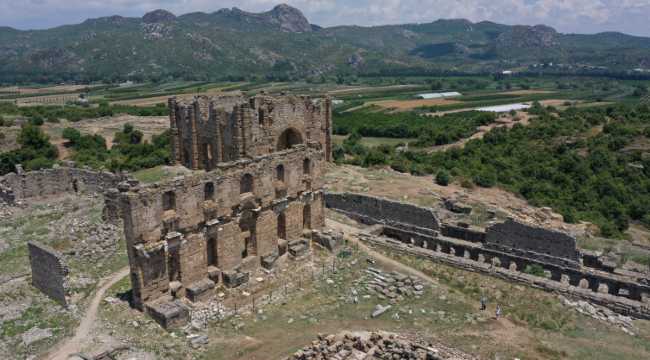
Located in Belkıs Mahallesi (neighborhood), Serik district of Antalya, Aspendos Ancient City’s history and traces of life date back approximately 6,000 years. The city, which boasts one of the few remaining intact ancient theaters and aqueducts, also features an agora on a hill surrounded by walls, a monumental fountain, temple, stadium, council building, and a Roman basilica, all standing the test of time.


Excavations, which began as a surface survey in 2008, have been ongoing since 2022 under the leadership of Assoc. Prof. Dr. Mustafa Bilgin from Afyon Kocatepe University. As part of this year’s “Legacy to the Future Project” by the Ministry of Culture and Tourism, intensive work at the agora area led to the discovery of the statues in a two-story shop from the Roman period.
“This surprise suggests that the area might have been a sculpture workshop”
Hüseyin Tolga Candur, the Deputy Director of the Aspendos Excavation, mentioned that recent studies had uncovered evidence of habitation in the region dating back 6,000 years. He noted that Aspendos, with its theater and aqueducts, was one of Turkey’s best-known and most-visited archaeological sites. However, he added that the city’s main large structures were located in the acropolis area, which were relatively unknown.
Candur explained that excavations had been ongoing in a two-story shop/stoa complex on the western side of the agora, consisting of 15 shops and storage areas. “In the 14th shop, we encountered a surprise. This discovery suggests that the area might have been a sculpture workshop during the Roman period,” he said.
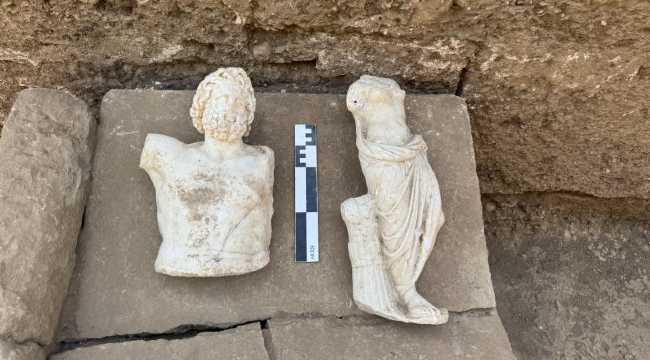
“Next to a workbench from that period, we found a bust of Zeus, the chief god of ancient Greece. The head is intact, and there is a muscle fold in the abdomen area, indicating he might have been depicted seated. However, the lower part was cut off and later reused. The other statue is of Aphrodite, the goddess of love and beauty, known as Venus in Rome. The statue shows her holding her robe, semi-dressed, and standing, with an imperial armor support apparatus beside her. The statues are about 50 centimeters high. Based on the delicate craftsmanship and various features, these statues were likely sculpted in the early phase of the Roman Imperial Period. These findings are supported by previously discovered archaeological materials,” Candur explained.
The statues will be documented, cleaned, and restored before being handed over to the Antalya Museum.
Candur stated that excavations in other areas of the shop complex were ongoing and were expected to be completed this year. “We expect more surprises and possibly architectural innovations in the future,” he added.
“With the support from our ministry, our work pace has reached a remarkable level. We plan to increase our workforce in the coming period. If these supports continue, we aim to complete what would have taken 10-15 years of excavation in a much shorter time,” Candur concluded.