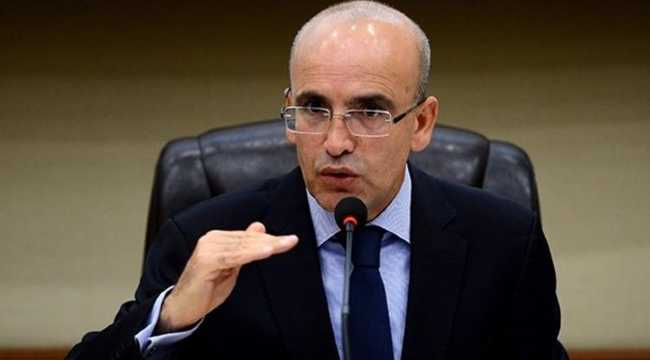
Speaking at the Antalya Diplomacy Forum during a panel titled “Global Challenges and Turkey’s Outlook,” Minister of Treasury and Finance Mehmet Şimşek stated, “Inflation is falling, and it will continue to fall. We’ve done everything to implement this program, there is strong political support, and we are determined.”
During the “Global Challenges and Turkey’s Outlook” session of the Antalya Diplomacy Forum, Minister Şimşek provided a comprehensive assessment of the fragile state of the global economy and Turkey’s position within this landscape.


“The global economy is going through a period of volatility”
Minister Şimşek pointed out that the global economy is experiencing a period of high uncertainty and volatility. He emphasized that Turkey is relatively more resilient to global challenges and outlined ongoing reforms in areas such as foreign trade, energy transformation, artificial intelligence, and the defense industry.
“Trade wars and protectionism are straining global production”
Citing IMF forecasts of a 7% decrease in global GDP, Şimşek said, “Trade wars, protectionist measures, and geopolitical tensions are straining global production. China is dominating global manufacturing, while Europe, the U.S., and Japan are losing strength.”
“Domestic demand takes precedence over exports”
Şimşek underlined that Turkey’s growth model is not export-based, saying, “Historically, net exports have contributed little to growth and have often been a limiting factor. The main driving force of the Turkish economy is domestic demand and investments.”
“Turkey is less fragile”
As a result, Şimşek said, Turkey is less vulnerable to the global contraction in trade.
He also noted that 62% of Turkey’s exports go to countries with which it has free trade agreements, primarily the European Union. “As long as relations with these countries continue, a significant portion of our exports will remain protected,” he said.
Highlighting the importance of regional integration, Şimşek added, “You rise with your neighbor, and fall with your neighbor. Turkey wants a peaceful and stable region because it’s in our best interest.”
New energy and logistics corridors
Şimşek explained that Turkey is part of the Middle Corridor that stretches to China, and described development corridor investments that will link Iraq to Turkey, and from there to London and Beijing. Emphasizing the cost-effective and efficient logistics solutions these projects offer, Şimşek stated, “Connectivity is crucial. We are investing in peace, security, and prosperity—because we benefit from it.”
“Inflation is falling, and it will continue to fall”
Reaffirming their determination in the fight against inflation, Şimşek said, “Inflation is falling, and it will continue to fall. We’ve done everything to implement this program. We have strong political support and we are resolute. We also have the capacity to manage this process.”
He added that short-term market fluctuations might distort expectations, but the disinflation process will continue.
Şimşek noted that the limited depreciation in the exchange rate could be offset by falling oil prices and stated that tight monetary policy would have a clearly disinflationary effect. On the fiscal side, he affirmed that budget discipline would be maintained, with public debt standing at 25% of GDP.
Rising power in defense and AI
Minister Şimşek announced that Turkey’s domestic production rate in the defense industry has reached 80%. “25 years ago, we were one of the largest importers. Now, we are among the top 10 exporters. We have 3,500 companies and 1,100 active projects,” he said.
He also noted that while artificial intelligence will boost global productivity, its benefits won’t be evenly distributed. However, Turkey is among the countries producing a high number of graduates in this field.