


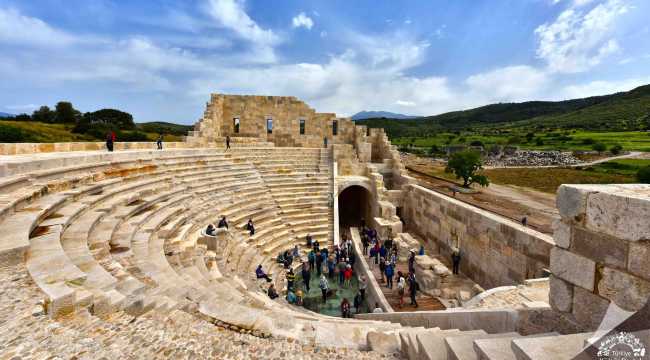
Patara Ancient City is located between Fethiye and Kalkan, at the southwestern end of the Xanthos Valley, in what is now the village of Gelemiş. It is one of the most important and oldest cities in Lycia. Excavations have been ongoing since 1988. Besides its archaeological and historical significance, Patara is also one of the rare beaches where Mediterranean turtles, Caretta-Carettas, have laid their eggs and hatched for millions of years.
History of Patara Ancient City


The city is mentioned as Patar in Hittite texts from the 13th century BC. Ceramic fragments found in the Tepecik Acropolis date back to the Middle Bronze Age, and a stone axe from before the Iron Age discovered on the eastern slope of Tepecik shows how ancient Patara was. Due to its location as the only place in the Xanthos Valley with access to the sea, Patara has maintained its importance throughout history. In inscriptions and coins, the city’s name is also recorded as Patara in the Lycian language.
PATARA BECOMES LEADING CITY OF LYCIA
In the 3rd century BC, Patara became the leading city of Lycia under Ptolemaic rule. By the early 2nd century BC, when Lycia came under the control of the Seleucid Kingdom, Patara was accepted as the capital of Lycia. This status was formalized in 167/168 BC when Patara gained autonomy from Rome and independence from Rhodes, becoming the capital of the Lycian League. Monumental structures built in the Hellenistic period, such as the Assembly Building and the Theatre, parallel this historical process. Patara did not lose its significance after coming under Roman rule; it served as a judicial center for Roman governorships and a naval base connecting Rome with its eastern provinces. In 43 AD, Lycia became a Roman province, and in 74 AD, Lycia and Pamphylia were merged into a single province, with Patara continuing as the capital.

AN IMPORTANT CENTER FIR CHRISTIANS DURING BYZANTINE PERIOD
Patara was renowned as an important oracle center for Apollo and was a significant port where grains transported from Anatolia to Rome were stored. The city remained important during the Byzantine period as a center for Christians. Saint Nicholas, also known as “Santa Claus,” was born in Patara. Additionally, St. Paul boarded a ship in Patara to travel to Rome. At the Council of Nicaea in 325 AD, Bishop Eudemos of Patara was the sole signatory for Lycia, indicating the city’s prominence during that period. Patara continued to be significant during the Middle Ages and remained an important center with the arrival of the Turks.
KURŞUNLU HILL OFFERS BEST VIEW OF CITY’S OVERALL LAYOUT
Entry to the present-day ruins of the city is through the well-preserved Roman Triumphal Arch, built in honor of the regional governor around 100 AD, as indicated by inscriptions. To the west of the arch lies a cemetery area with Lycian-type sarcophagi. At the southern end of the city, the theatre, rebuilt after an earthquake in 147 AD, is situated against Kurşunlu Hill. The hill offers the best view of the city’s overall layout, including the Vespasian Bath, Corinthian Temple, main street, harbor, and granary. The granary, located behind the marsh to the northwest of the hill, is one of Patara’s remaining monumental structures, built by Emperor Hadrian and his wife Sabina in the 2nd century AD. North of the theatre is the Assembly Building, where the Lycian League held its meetings. The city’s water supply came from a rocky area on the slopes of Kızıltepe, about 20 kilometers northeast, near İslamlar Village. The most monumental section of the aqueducts, locally called “Delik Kemer,” is located north of Fırnaz Pier.
“BEAUTIFUL VIDEO BY AT HOME IN TURKEY”


