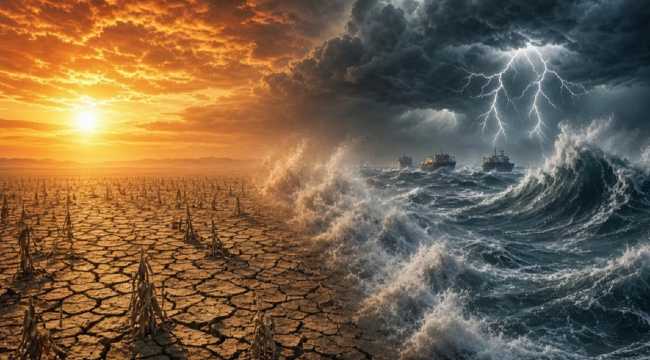
The world may be heading towards an exceptionally strong El Nino in 2026 and 2027, raising concerns that go well beyond extreme weather.
The US National Weather Service reportedly sees a more than 90 percent chance of an unusually strong El Nino in the Northern Hemisphere. There is also a significant possibility that it could become the strongest event since official records began in 1950.


If that happens, the consequences could be felt across energy markets, food production, shipping and global supply chains.
A Dartmouth College study has estimated that El Nino events could cost the global economy as much as 84 trillion dollars over the course of the 21st century.
For businesses, the important question is not simply how strong the weather event will be, but what happens when it hits an already fragile global economy.
Why El Nino matters to business
El Nino starts in the Pacific Ocean, but its influence can extend across the world by changing atmospheric circulation, rainfall and temperatures.
That matters because much of the global economy depends on predictable weather.
Agriculture needs reliable rainfall. Energy systems need to cope with changing demand. Shipping depends on navigable waterways and stable weather. Manufacturing depends on raw materials arriving from multiple parts of the world.
A major El Nino can disrupt several of these systems at the same time.
And this time, the global economy is already dealing with geopolitical tensions, energy risks and vulnerable supply chains.
Energy markets face another risk
Energy could be one of the first markets to feel the impact.
Extreme heat can increase electricity demand as households and businesses rely more heavily on cooling. At the same time, drought, storms and other extreme weather can disrupt energy production and transport.
The pressure could become particularly significant as electricity demand continues to rise because of data centres and artificial intelligence.
There is also a growing link between energy and water security. Large data centres require substantial amounts of electricity and water for cooling, making prolonged heat and drought a potential double challenge.
For companies, higher energy prices would quickly feed into production, transport and operating costs.
Food prices could rise again
Agriculture is another major vulnerability.
El Nino can produce drought in some agricultural regions and excessive rainfall in others. Lower yields of wheat, rice, maize and other staple crops can push prices higher across international markets.
Coffee, tea and cocoa producers can also be affected.
For many small farmers, a single season of severe drought, flooding or storms can create major financial problems. Limited insurance coverage and financial reserves can make recovery difficult.
The consequences eventually reach consumers through higher food prices.
Some agricultural regions may benefit from El Nino through increased rainfall, but those gains may not compensate for production losses elsewhere.
Shipping could become more expensive
Global trade could face another problem through maritime transport.
Changes in winds, storms and rainfall can affect major shipping routes. Drought can be particularly damaging to the Panama Canal, where lower water levels can restrict the number and size of ships passing through.
The 2023 and 2024 El Nino period showed how quickly this can become a business problem.
When shipping companies are forced to reduce loads or take longer alternative routes, fuel consumption, delivery times and transport costs all increase.
For companies already trying to make supply chains more resilient, another disruption would add further pressure.
Supply chains remain the biggest concern
The real economic risk may come from the way these problems interact.
Modern manufacturing depends on highly interconnected supply chains. A shortage of one raw material or component can eventually affect several industries.
Semiconductors are a good example.
Chip manufacturing requires large quantities of water, making production vulnerable to drought and water shortages. Mining operations can also be affected by extreme rainfall, drought and reduced hydroelectric power generation.
A disruption at the beginning of the supply chain can therefore reach manufacturers and consumers much further down the line.
For businesses, this makes alternative suppliers, strategic inventories and geographical diversification increasingly important.
What could El Nino mean for Turkey?
Turkey could also feel the effects, although the impact is unlikely to be uniform across the country.
El Nino does not directly control Turkey’s weather, but changes in global atmospheric circulation can influence conditions across the Mediterranean region.
One major concern is prolonged heat.
Hotter and longer summers can increase electricity demand, put additional pressure on water resources and increase the risk of forest fires.
Agriculture could also face greater uncertainty if rainfall becomes less predictable.
Some areas could experience longer dry periods, while others could face sudden heavy rainfall and flooding.
For Turkey’s businesses, particularly in agriculture, food production, energy and tourism, this uncertainty could become more important than the El Nino label itself.
Turkey’s economic exposure
The effects would not necessarily stop at the farm or the power plant.
A poor agricultural season can raise food prices. Higher food prices can add to inflation. Higher electricity demand can increase energy costs. Disrupted international transport can raise the cost of imported goods and components.
These effects can then move through the wider economy.
Turkey’s position as a major trading and manufacturing economy makes supply chain resilience particularly important.
Companies that depend heavily on a single supplier, country or transport route could face greater risks if extreme weather disrupts production elsewhere.
Businesses need to prepare for several shocks at once
The lesson from El Nino is therefore broader than weather forecasting.
Companies need to consider what happens if extreme weather arrives at the same time as an energy shock, geopolitical crisis, trade disruption or supply chain problem.
Energy diversification can reduce exposure to price shocks. Alternative suppliers can reduce dependence on a single source. Strategic inventories can provide a buffer when deliveries are delayed.
Water efficiency, resilient infrastructure and better risk monitoring can also reduce exposure to extreme weather.
Artificial intelligence may help companies identify weaknesses in complex supply chains earlier, but technology itself should not become another single point of failure.
The bigger risk is the combination of shocks
A strong El Nino may last only a few seasons.
The vulnerabilities it exposes could last much longer.
The global economy is increasingly operating in an environment where climate events, geopolitical tensions, energy disruptions and supply chain problems can overlap.
For businesses, resilience is therefore becoming an economic issue rather than simply an environmental one.
For Turkey, the priorities are particularly clear: water security, agricultural planning, energy resilience, wildfire prevention and stronger supply chains.
Nobody can say exactly what a potential Super El Nino will bring.
But businesses and governments do not need to predict every detail.
They need to be prepared for a world in which several risks can arrive at the same time.
Source: ekonomim.com / translated by BTT