


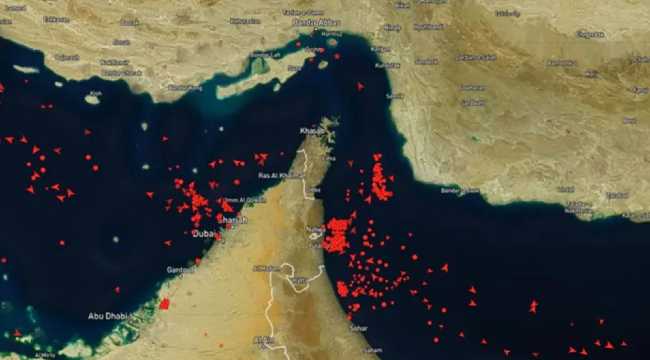
The flow of oil tankers through the Strait of Hormuz has almost completely stopped due to the ongoing conflict between Iran and the U.S.-Israel coalition. More than 700 vessels are waiting in this strategic corridor that links Middle East oil and gas production to global markets, hoping for the conflict to end.
After joint U.S. and Israeli strikes on Iran over the weekend, ship operators suspended all passage due to skyrocketing insurance costs. Shipments that were averaging 19.8 million barrels per day so far this year dropped by 86% compared to the 2026 average on March 1. The chain of shipments, representing roughly 20% of global daily oil consumption, is now stranded in the middle of the sea. Among the vessels clustered on both sides of the strait are 334 crude oil tankers and hundreds of ships carrying refined products.


Traffic at a Standstill
Data from analytics firm Kpler shows that on February 27, 15 tankers transported 21 million barrels, while by March 1, only 3 tankers managed 2.8 million barrels. This represents an 86% collapse compared to the daily 2026 average of 19.8 million barrels.
Even though crude oil loading operations continue in the region, reduced eastbound departures and longer waiting times are expected to delay arrivals and push freight costs higher. Located west in the Persian Gulf and east in the Gulf of Oman, 706 non-Iranian-flagged tankers create a serious risk of supply disruptions in global energy markets.
Strait of Hormuz Closed
Iran’s Islamic Revolutionary Guard Corps has sent warnings to ships attempting to pass through the strait, stating that “no vessel will be allowed to pass.” Some container ships have already rerouted to avoid the area. Meanwhile, the United Kingdom Maritime Trade Operations (UKMTO) raised the maritime security level to the highest “critical” category. The agency explained that the upgrade followed the confirmation of multiple attacks on commercial ships in the Gulf of Oman and off the UAE coast over the weekend.
Keywords: #StraitOfHormuz #oiltraffic #IranUSIsraelConflict #globaloilmarket #tankershipments #oilprices #maritimesecurity #PersianGulf #GulfofOman #shippingdelays #energycrisis #UKMTO #freightcosts

