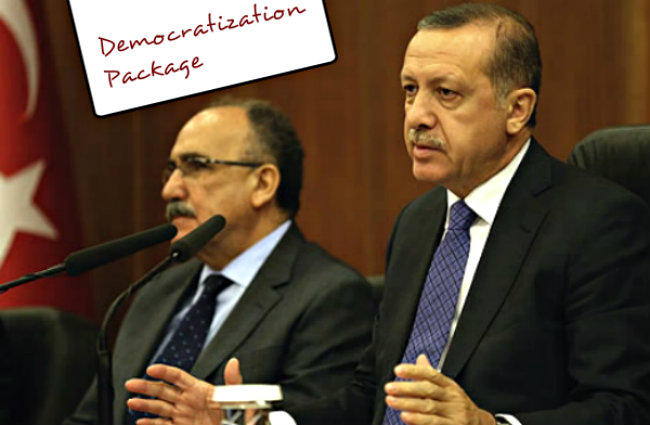


At a press conference in Ankara on Monday 30th September 2013, Turkish PM Erdogan announced the “democratization package”, a series of reforms to improve minority rights, individual freedoms and likewise with the hope it would help to partly recover the democratic credentials Turkey had lost recently.
The package brings a number of measures to be taken by the government, such as lifting the ban on wearing the headscarf in public spaces, softening rules on the use of minority languages, Kurdish mainly as well as returning lands which is supposed to belong to Mor Gabriel, the oldest surviving Syriac Orthodox monastery.


Those who expected to hear some real radical steps were disappointed to see by no means could the package be referred to as a breakthrough. The package was rather described as evasive if not unclear by many.
For instance, Erdoğan announced they were to allow Kurdish in private institutions in which situation the Peace and Democracy Party (BDP) and some others were not content as they require Kurdish to become part of the curriculum in state schools in the southeast.
Then again, the PM stated that the 10 percent electoral threshold could be lowered but he failed to suggest a new threshold. As for Alevis, the largest religious minority in Turkey on the other hand
Erdoğan announced they would rename a university in central Anatolia after Hacı Bektaşı Veli, a prominent 13th century Muslim mystic, celebrated as a saint by the heterodox community. Alevis though felt tantalized too, as they expect to be granted equal rank to the majority Sunnis who enjoy many privileges provided by the state.
In the meantime, following a PKK decision to halt withdrawal from Turkey into bases in Iraq because Turkey did not behave in compliance to its commitments, there were strong fears the peace process could be seriously harmed.
In fact, all parties have been concerned for a while that the process has slowed down recently. When we look at the events Turkey has gone through during the last months we can see that Erdoğan’s plan to trade enhanced Kurdish rights, or even political status, for a constitutional change installing a presidential system supported by the BDP has fallen through as a result of the Gezi Park protests.
Another important issue has been Ankara’s political and military aid for Islamist Jabhat al-Nusra that has been clashing with PYD (similar to PKK) in Syria and it has been very disturbing for many parties both locally and on the international level, to include PKK in the first place.
Taking all above into consideration, Erdoğan’s package was regarded as a step to keep the peace process with the Kurdish Workers’ Party (PKK) and the talks with its imprisoned leader Abdullah Öcalan, alive, by many experts.
To recap, under the light of all above data, Erdoğan’s package is interpreted as an attempt to face pressure due from all opponents, BDP and the PKK to be first in the row. However, the package is also considered to be an encouraging sign to solve the problems on the agenda and provide Kurds and other minorities with the rights they have long deserved.
02.10.2013
Editor