Are U.S. and Russia cooperating on Ukraine that could lead to confrontation with EU and the world?
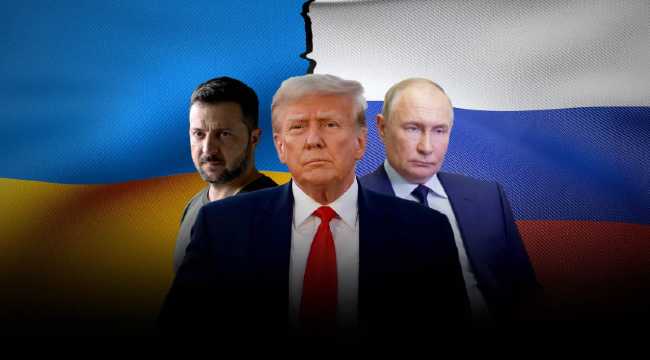
It goes without saying very important things keep happening in Ukraine. The most recent incident at the White House drew the attention of the whole world to this issue again. Regarding this topic we are down below sharing a very interesting and informative excerpt from an article on media.
“Since Donald Trump’s inauguration on January 20, he has repeatedly stated that the U.S. will now focus only on its own borders and China. Europe must now ensure its own security. Looking at the defense budgets of the top 15 countries with the highest defense spending by the end of 2024, it is clear that the U.S. has positioned itself securely.

The defense budgets are as follows:
- U.S.: $968 billion
- China: $235 billion
- Russia: $146 billion
- Germany: $86 billion
- United Kingdom: $81 billion
- India: $74 billion
- Saudi Arabia: $72 billion
- France: $64 billion
- Japan: $53 billion
- South Korea: $44 billion
- Australia: $36 billion
- Italy: $35 billion
- Israel: $34 billion
- Ukraine: $28 billion
- Poland: $28 billion
The total defense budget of the 14 countries following the U.S. is equivalent to the U.S. defense budget, reaching $1 trillion.
After World War II, the U.S. established the global monetary system based on the Gold-Dollar standard through the Bretton Woods Agreement between 1944 and 1971. At that time, the U.S. took major steps, creating the IMF and World Bank, to become the sole authority over the international payment system and monetary management. In 1971, President Nixon was forced to exit the system due to the global oil crisis and rising inflation in the U.S. From the 1970s onward, countries adopted various currency systems—free-floating, managed floating, and rigidly pegged to the dollar—which supported the establishment of the U.S.’s current financial infrastructure.
The U.S. dollar, with minimal production costs beyond ink, paper, and printing, generates an annual seigniorage of $2.3 trillion globally. Given that all commodities are priced in U.S. dollars and the U.S. dollar still holds the top spot with 60% in the global reserve currency ranking, while the Euro holds 20%, it is evident that the U.S. will accelerate the imposition of its military and monetary policies during the Trump administration.
However, the proposal, which was put on hold during last week’s heated discussions at the White House, for the U.S. to take a 50% share of the total revenue from Ukraine’s rare earth mineral extraction, usage, and port income in exchange for a $500 billion war budget support, is seen as an unfair suggestion. This is because the U.S. has provided far less financial support than the European Union. In three years, the U.S. has provided 119 billion euros in aid to Ukraine, while the EU has provided 116 billion euros in non-military economic support and 87 billion euros in military and economic aid from its member states. Additionally, the U.K. has given 27 billion euros, Japan 17 billion euros, Norway 15 billion euros, and Canada 12 billion euros. Given these figures, the U.S. claim to 50% of Ukraine’s potential mineral revenue seems an unjust foreign policy proposal.
In fact, during the early months of the war, a map showing that the eastern regions of Ukraine, occupied by Russia, contain mineral reserves worth $7.8 trillion was shared with the public last week. Under the current agreement proposed by the U.S., the estimated $7 trillion worth of mineral reserves remaining in Ukrainian-held territories would be shared until the U.S. collects its $500 billion economic bill.
In his latest statement on social media, Zelensky expressed that Ukraine is always ready to sign the agreement prepared by the U.S. in any format and sees it as a step toward more security and solid guarantees, hoping that it will function effectively.
Ultimately, it appears that the U.S. and Russia are cooperating on Ukraine, which will lead to a major confrontation with the EU and the rest of the world. With populist leader Trump, who has a history in real estate dealings, and autocrat Putin, we will soon witness how they will create new problems for the world.”
Source: ekonomim.com
Excerpt from article by Prof. Dr. Evren Bolgün (translated by BTT)