
Excavations made at ancient city of Kelenderis in Mersin to fully uncover a 2,500-year-old fortress
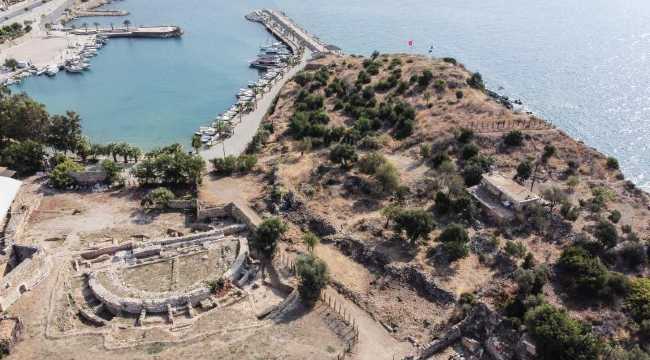
In the ongoing archaeological excavations at the ancient city of Kelenderis in Mersin, efforts are being made to fully uncover a 2,500-year-old fortress, parts of whose walls have already been unearthed. Located in Aydıncık, a district that has hosted many civilizations due to its strategic location in the Eastern Mediterranean, the site is being excavated under the leadership of the Ministry of Culture and Tourism.
The excavation work is being carried out by a team of 30, led by Associate Professor Mahmut Aydın, Head of the Archaeology Department at Batman University. The ancient city of Kelenderis, which includes a Roman-era bath, a basilica-planned church, an odeon (a venue for musical performances), and a necropolis, is undergoing year-round excavation efforts.

Previous excavations revealed parts of the fortress walls, which are believed to date back 2,500 years. The team now aims to fully uncover the entire structure that remains buried underground.
Excavation leader Mahmut Aydın highlighted that the focus of the archaeological work is currently on the fortress. He noted that the fortress dated back 2,500 years and was one of the strongest fortresses in the Cilicia region during the Roman period. Despite its age, the fortress remains largely intact, with minimal damage.
Aydın emphasized the significance of the fortress and stated, “This was a powerful fortress about 2,000 years ago during Rome’s civil war, but we didn’t know how much of it was still intact. Our work has revealed this. We plan to fully uncover and restore the fortress within the next five years, and we hope to find important artifacts during the excavations.”
HIGH TOURISM POTENTIAL DUE TO ITS LOCATION ALONG MERSIN ANTALYA HIGHWAY
Aydın further mentioned that the intact structure of the fortress walls would be advantageous in the excavation and restoration process. He also noted that due to its location along the Mersin-Antalya highway, the ancient city of Kelenderis had high tourism potential. A project to open the site to visitors is currently in the approval stage, and once approved, they plan to introduce the site to tourists shortly. Initially, they will focus on areas where excavation and restoration have been completed, followed by the fortress itself. Aydın added that the archaeological work would gain momentum through the “Heritage for the Future” project led by the Ministry of Culture and Tourism.