
Do We Really Know Ourselves? A Great Book: “I’m OK, You’re OK”
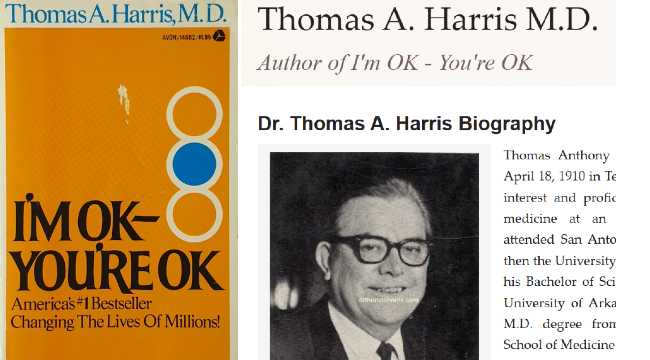
How about a little PSYCHOLOGY for today’s chat? Don’t worry, no heavy FREUD topics here… After all, the writer of these lines is not a psychologist either… But this kind of subject is of great interest, and understanding the behavior and motives of human beings is crucial for him… Just like AWARENESS, which is equally important… Can we say that these two are not connected in some way?
In this article, I wanted to talk about an important book. This text had been previously published on another website of ours, and I thought it would be worth sharing here as well. Please read it, we believe many of you will find it useful.

“I AM OK YOU ARE OK” – This book by Thomas Harris is based on the work of another scientist, Eric Berne, who developed the Transactional Analysis approach emerging in America in the 1970s. Thomas Harris (a psychologist) built upon this framework of Eric Berne and achieved tremendous success with the book I’m OK, You’re OK, staying on the bestseller lists for a long time and opening new windows in people’s minds.
The book’s MAIN THEME is that the behavioral patterns we currently exhibit are the result of past influences that have been recorded in our brains. While it might not be possible to completely erase these records, we can at least learn to control them (not repress them)… if we can understand their causes, etc. In this way, we can partially eliminate some of the behavioral patterns that cause problems in our lives.
THE PERSONALITIES THAT CONTROL US
In the book, Dr. Harris states that we have three types of personalities within us, and that these personalities (with one usually being more dominant) govern our actions: CHILD, PARENT, and ADULT.
For example, if a person had a very dominant mother or father when they were young, the “PARENT” personality might be more dominant in that person.
He also says that HUMAN PERSONALITY DEVELOPMENT OCCURS IN 4 STAGES:
- 0-2 Years Old
- 3-11 Years Old
- 12-18 Years Old
- 18 and above (Note: the ages may vary, don’t worry about the exact numbers).
For example, between 0-2/3 years, a baby is highly open to external influences and records them without filtering them through logic (it is known that the brain is an incredible recording machine, and nothing recorded there, except for the death of the cell, is ever lost… although we may not remember it, that information is stored in the cell it was recorded in).
However, the unfortunate part is that the experiences of a baby in this period are often not very positive. The baby feels powerless, inadequate, and dependent… while those around them can do everything, they themselves can’t even communicate their problems.
This experience creates a negative record in the baby’s mind, such as “I AM NOT OK, YOU ARE OK” — meaning, “I am not normal, but you are normal.” As mentioned above, the baby doesn’t think, “Well, I’m just too small to do anything, it’s normal that I can’t do anything, these things will get better when I grow up, this is normal.”
Between ages 3-7/8, as the child begins to understand and reason (the logic filter starts to function), we see the “I’M NOT OK, YOU’RE NOT OK” stage. This means, “Yes, I have some shortcomings, but you do too. I accidentally knocked over the table, but you yelled at me, so you’re not normal/OK either.”
Between ages 8-18, it is a dangerous period. The child begins to enter the “I AM OK, YOU ARE NOT OK” stage and starts to feel justified in whatever they do. We call this the “blue age” (teenage years). If a person stays in this stage, it becomes truly problematic. This is because they might justify all their wrong actions and even find excuses for their behavior. In fact, it is believed that many abnormal (inappropriate, criminal) personalities come from individuals who were unable to progress beyond this stage.
From 18 and above, the desired stage is for the individual to reach the “I AM OK, YOU ARE OK” stage and complete their development. This means, “I am okay/normal, and so are you.” This is a stage that embraces tolerance, maturity, understanding, problem-solving, and other positive personality traits.
I AM BETTER THAN YOU ARE
Now, up to this point, we have summarized what Harris wrote. Here, we begin to address a very important issue…
We know that all of us pass through the first stage (0-3 years) with our helpless and weak state. We are all affected by that period, to some extent. During this time (and also during the later periods), an “insecurity, weakness” or “LACK” feeling can develop, often without our awareness or acceptance.
But as this feeling is irrational, we can “throw it off” by thinking it is nonsense, can we not? The truth is it doesn’t work that way. Because these early recordings are made without any filtering, when any external factor triggers these old recordings, we recall them as they were, feeling exactly as we did at the time. This is something beyond our control.
It’s like recording something on a tape and then playing it back — no matter how many times you play it, the recording will always be the same, unchanged.
So, the recordings made during these stages are so powerful that throughout our lives, we may try to compensate for them, often unconsciously. That’s why we might spend our lives trying to heal this wound by seeking out praise, recognition, or validation.
This is where the feeling of “I AM BETTER THAN YOU ARE” comes into play. Yes, for many of us, our lives revolve around this feeling. “My daughter is prettier than yours,” “My husband is richer than yours,” “I’m more handsome than you,” “My car is more expensive than theirs,” and so on. Because when we can feel this way, our ego is stroked. “Oh, I’m not the worst, least, or most helpless… In fact, I’m even better than you.”
This is why when we receive compliments, recognition, or see ourselves being better than others, we feel lighter, happier (and perhaps even better or healed).
Thus, many people win others’ hearts by making them feel “how nice, useful, and beautiful they are.” This can even be used as an advantage in the workplace (sales, etc.).
LET’S NOT FORGET… A simple, well-timed compliment can open many doors and win someone’s heart.
Available on below link (I think)
OPEN LIBRARY: https://openlibrary.org/books/OL10487540M/I%27m_OK_You%27re_OK
Written by Mustafa HUNCA