Excavation of ancient Prusias nearing completion, with goal to open 10,000-seat theater to tourism next year
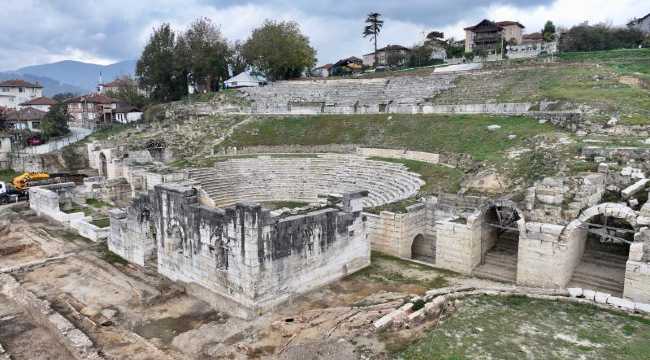
Dating back to the 3rd century BCE, the excavation of the ancient city of Prusias ad Hypium is nearing completion, with the goal of opening its 10,000-seat theater to tourism next year. With permission from the General Directorate of Cultural Heritage and Museums and support from Düzce Municipality, approximately 95% of the excavations, led by the Konuralp Museum Directorate, have been completed over the past five years.
Significant findings have emerged in the ancient city, located in the Konuralp neighborhood, where Prusias ad Hypium endured multiple severe earthquakes across different eras. Despite this, the theater remains largely intact, and restoration efforts are planned to begin soon, with the goal of making this well-preserved structure accessible to visitors in 2025.

Prof. Dr. Musa Kadıoğlu (scientific advisor for the excavation and Archaeology Professor at Ankara University) explained that the excavation work in the theater area was nearing its final stages. Work on clearing structures to the south of the temple is ongoing, with restoration in this area set to begin soon. He noted, “New structures have appeared atop the temple area. Once we clear these, the excavation will be complete. When the restoration projects are approved, this site will become more navigable and understandable.”
He emphasized that the continuous 12-month excavation efforts over the past five years were nearing an end. “We expect to complete the work by the end of this year, allowing us to start restoration in 2025. This area is not just the largest ancient site in the Western Black Sea; it is also the best-preserved theater in the entire Black Sea Region, from Trabzon to Istanbul. Recent findings and sculptural artifacts underscore the significance of this structure.”
KEY FINDINGS AT THE ANCIENT CITY
Among the discoveries are sculptures believed to be 2,000 years old, including the head of Medusa (the snake-haired monster in Greek mythology known for turning those who gaze upon her into stone), mask sculptures, a grotesque (Roman-era decorative figure), and a vaulted ceiling structure. In the stage area, relief sculptures of the Greek god Apollo and the goddess of victory and the hunter Actaeon have also been found.
Last year, a lion-themed mosaic and a statue head of Alexander the Great, associated with the “Dionysian Cult Space,” were unearthed, exciting archaeologists. The excavations also revealed that the theater had been repurposed during the Eastern Roman period and was used as a residential area starting from the Ottoman period.
Largely intact, this theater is one of the best-preserved in Bithynia, encompassing today’s Eastern Marmara and Western Black Sea regions, and stands as one of Anatolia’s well-preserved theaters. Recently, a bust believed to belong to M. Iulius Proklos, who commissioned the construction of the stage building around 1,800 years ago, was also discovered.