Withholding Tax Hike on Turkish Lira Deposits Sparks Market Confusion

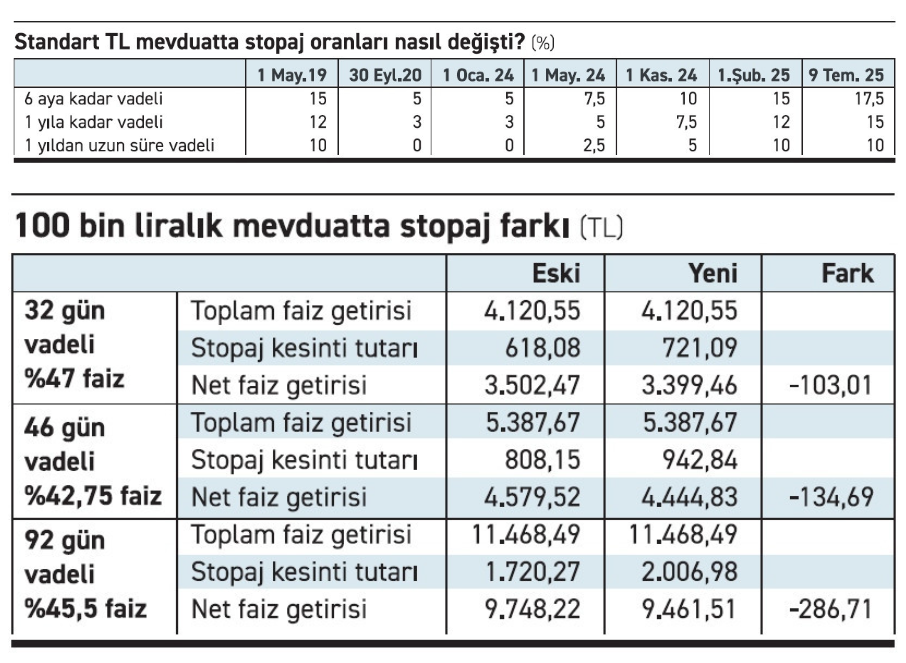
Unexpected Policy Move Amid Rate Cut Expectations: The Turkish government’s recent decision to increase the withholding tax on short-term Turkish lira (TL) deposits and investment funds has caused widespread confusion and concern in financial markets. The rate was raised from 15% to 17.5% for TL deposits with maturities of up to six months and for standard investment funds.
This policy shift came as a surprise, especially during a period when the Central Bank of Turkey is expected to begin easing interest rates. Many investors and economists had anticipated a tax cut to incentivize TL-based investments—making the decision both unexpected and difficult to interpret.

Aimed at Revenue or Rate Signaling?
While the official rationale has not been clearly outlined, most analysts view the move as a way to increase tax revenues in the short term. However, the broader implications suggest that it might also be aimed at managing interest rate expectations. The unexpected tax hike may signal that the Central Bank’s anticipated rate cuts will be more limited than markets had priced in. Indeed, the expected interest rate reduction has been revised downward, from 350 basis points to 250, following the tax announcement.
A Push Toward Government Bonds?
Another interpretation is that the government may be attempting to redirect investor attention toward government securities, which still enjoy a zero withholding tax. This would support public borrowing needs without relying on short-term capital inflows. However, such a strategy, if it exists, remains speculative. The more immediate and concrete effect is a reduction in the real return on TL-denominated assets, potentially discouraging savers and investors at a time when inflation continues to erode purchasing power.
Impact on Savers’ Real Returns
The increase in withholding tax directly reduces the net earnings on TL deposits. According to calculations, a 100,000 TL deposit at a 32-day maturity with a 47% annual interest rate would have previously returned 3,520 TL in interest. Under the new tax rate, the same deposit now yields 3,399 TL—an immediate loss of more than 100 TL. Similar losses are seen with longer maturities. For instance, a 92-day deposit at 45.5% interest results in a reduction of nearly 289 TL in post-tax returns. In a high-inflation environment, these losses are meaningful for households relying on interest income.
Market Reactions: ‘Inexplicable’ and Unclear
The reaction from market professionals and economists has been swift and critical. On social media platform X, economist Ali Ağaoğlu questioned how the decision could be justified, while respected economist Mahfi Eğilmez simply responded: “Inexplicable.” Their reactions reflect broader market sentiment: the decision contradicts recent trends in monetary policy and sends mixed signals to investors about the government’s economic strategy.
An Unstable Policy Trajectory
The withholding tax on TL deposits has seen several significant changes over the past few years. It was reduced sharply in September 2020, during the pandemic, to encourage domestic saving and liquidity. However, beginning in mid-2024, the rate started climbing again, reaching 15% by February 2025. With the latest hike to 17.5%, the tax burden on TL-based savings has returned to pre-pandemic levels. Investment funds, which used to enjoy zero withholding, are now taxed at the same rate as standard TL deposits—eliminating previous incentives and further narrowing the range of attractive short-term investment options.
A Policy That Raises More Questions Than Answers
This latest move introduces new layers of complexity into Turkey’s already volatile economic environment. While the tax hike might support short-term fiscal objectives or adjust market expectations around interest rates, it risks weakening investor confidence in TL assets and sends mixed signals at a time when clarity is most needed. In the absence of a detailed policy explanation, economists and investors are left speculating, adding yet more uncertainty to Turkey’s investment climate.