Travel Turkey: Artifacts from the Roman period unearthed in Düzce
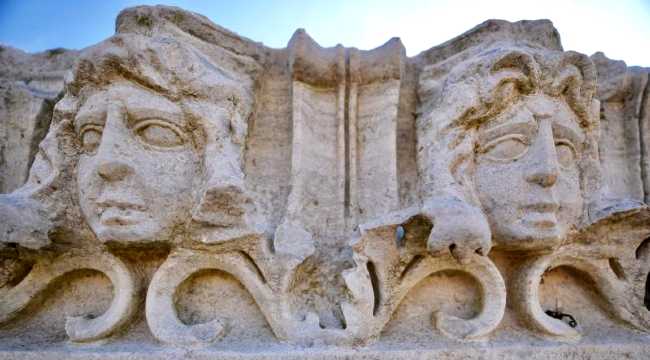
During ongoing excavation work in the Prusias Ad Hypium Ancient City in the Konuralp region of Düzce, three artifacts believed to be from the Roman period have been discovered.
Excavation efforts in the ancient city, which dates back to the 3rd century BC, have been ongoing for five years, under the supervision of the Konuralp Museum Directorate, with the permission of the General Directorate of Cultural Heritage and Museums and the support of the Düzce Municipality. The excavations are conducted year-round without interruption.

Among artifacts uncovered are head of a Medusa statue, believed to be of Alexander the Great
The ancient city, which has been damaged and altered by past earthquakes and restoration efforts, has yielded several significant discoveries. Among the artifacts uncovered so far are the head of a Medusa statue, the head of a statue believed to be of Alexander the Great, a statue of Apollo, a lion mosaic, a portrait bust possibly of M. Iulius Proklos, the patron of the ancient theater’s stage building, and a water storage pool from the Byzantine period. These have been added to the cultural heritage inventory.
Recently, three new Roman-period items were uncovered: a baked clay theater ticket, a figurine depicting Aphrodite, and a Thyrsus figure.
Eighty percent of the theater of an ancient city from 2,300 years ago, already uncovered
Düzce Mayor Faruk Özlü, speaking at the ancient city site, emphasized the significance of preserving the city’s 2,300-year history for the future. He mentioned that about 80% of the theater area had now been uncovered and expressed excitement at finding historically important artifacts in pristine condition.
Özlü also noted that the region was a prime candidate for becoming a full archaeological site, revealing that beneath this settlement lied a Roman city, a discovery made by specialists. “We understand from the artifacts we’ve uncovered that we may have found items that could change the course of history,” he said.
He further added that with the restoration of the ancient theater, it would be transformed into a cultural and arts center with a capacity of 10,000 people, and that numerous cultural assets had been uncovered through the ongoing excavation work.